
Other Festivals & Fasts
We have a children’s party and have also recently had a communal ‘salt beef & latkes’ dinner, with special guest speaker.
Our Chanukah Craft Fair raised hundreds of pounds for the shul, Kisharon and Jewish Women’s Aid – see here for some photos
Click here to listen to a series of Rabbi Kurzer’s podcasts for the eight nights.
Photos from Purim in Pinner


Purim Programme 2025
We had a full programme of events including several megillah readings, a children’s fancy dress party and a communal festive meal.
Rabbi Kleiman’s Purim Summary 2025
Ta’anit Esther, Thursday 13th March
The Fast of Esther will take place this coming Thursday 13th March and will start at 4.41am. Shacharit will include selichot and leyning. Mincha is at 1.30pm to which it is customary to bring three 50 pence pieces representing the three half shekels donated in Temple times on the eve of Purim. If you don’t have three 50 pence pieces, you can donate at least £1.50 to acquire those that will be available on a tray which can then be used as your half- shekel contribution. There will be a later opportunity to bring your half-shekel donation at Ma’ariv, commencing 6.45pm, which is three minutes after the fast ends at 6.42pm.
Although the fast is usually broken after the Megillah, if you are feeling weak before hearing the Megillah, from 6.42pm, you can break your fast with a drink (hot or cold), some fruit and a small quantity of Mezonot. Light refreshments will be available in the Shul kitchen.
Purim Evening, Thursday 13th March
Pinner Shul will be offering two Megillah readings. Ma’ariv and Megillah reading for both men and women in the main Shul will begin at 6.45pm. The Megillah reading by women for women only will also begin at 6.45pm.
Everyone will come together after the Megillah readings for the communal supper for which you must have already booked to attend.
Shacharit and Megillah reading at Pinner Shul will begin at 7.00am. A later Megillah reading will take place at Gesher school.
Hearing the Megillah is the first of the four mitzvot of Purim. The other three mitzvot performed on Purim day are as follows:
Matanot L’Evyonim
This is the mitzvah to ensure that those in need receive direct help from charitable funds on the day of Purim itself. The Rambam states “It is better to give more Matanot L’Evyonim than to spend more on one’s Purim Seudah… for there is no greater joy than gladdening the hearts of those in need…”. As a minimum, Matanot LeEvyonim should be a significant donation given to at least two recipients. I will be distributing Matanot Le’Evyonim to those in need locally on Purim day and so anyone who wishes for me to facilitate the mitzvah on their behalf is welcome to bring me their cash donations anytime during the morning of Friday 14th March.
Alternatively, there are a number of organisations, including the United Synagogue, that enable you to make your donation for Matanot Le’Evyonim online for distribution on Purim day.
Mishloach Manot
This is the mitzvah to give at least two items of ready to eat food or drink to a fellow Jew. This can be done to a family, indeed to anyone in the community whether you’re already acquainted with them or not as many times as you wish. It’s the gesture that matters, promoting harmony and friendship so you don’t need to go to great expense with something elaborate.
Purim Seudah
This is the festive Purim meal which in most years would tend to take place towards the end of the day before sunset.
Since Purim this year falls on Friday, there is somewhat of a conflict between the mitzvah of the Purim Seudah and the requirement to preserve an appetite for the Friday night Shabbat meal. As such, the Purim Seudah this year should take place in the morning, starting before 12.10pm (Halachic noon). For those not going to Shul, one should daven Mincha in the middle of the meal no earlier than 12.40pm. If one runs late, and with no choice, the Seudah should start at the very latest by 3.07pm (the end of the ninth hour of the day).
However, there is another option if it is simply too rushed to sort out your matanot le’Evyonim, mishloach manot and start your meal by 3:07pm.
- Wash and have bread before 5.50pm.
– Ideally, you should have wine as part of your seudah (this is unrelated to the fact that it is leading into Shabbat). - Stop eating before 5.50pm.
- Go to Shul for davening. (See below if you’re not going to Shul).
- Come home and bring out two loaves of bread
- Spread a cover over all the bread.
- Recite Kiddush
– Have you been drinking wine during the Purim seudah (as is ideal)?
– Yes → Say Kiddush WITHOUT Borei peri hagafen but WITH holding a glass of wine
– No → Say Kiddush as normal, WITH Borei peri hagafen - Eat Bread
– Do NOT make Hamotzi, but have two whole loaves. You may wish to hold them up together and say “Li’kavod Shabbat kodesh,” or “this is in honour of Shabbat”.
– Eat at least an ounce of bread after Kiddush and continue your meal. - Recite Birkat HaMazon
– If you have not davened Ma’ariv yet → Say “Al HaNissim and Retzeih”.
– If you have davened Ma’ariv → Say only “Retzeih”.
If you’re not going to Shul in the middle of your Purim meal.
Daven Mincha (no earlier than 12.40pm) before the Purim Seudah. Make Hamotzi and enjoy your Seudah with wine. Stop at 5:50pm to sing Kabbalat Shabbat. Bring out your two challot, cover them and make Kiddush.
- Do NOT make Hamotzi, but have two whole loaves. You may wish to hold them up together and say “Li’kavod Shabbat kodesh,” or “this is in honour of Shabbat”.
- Eat at least an ounce of bread after Kiddush and continue your meal.
- Recite Birkat HaMazon including Al HaNissim and Retzeih.
- Daven Ma’ariv after the Shabbat meal.
This is the day on which the walls of Jerusalem were breached prior to the destruction of the Second Temple although there have been many tragedies in our history on this day, from the smashing of the first Tablets by Moses at the foot of Mt Sinai to atrocities in the Holocaust including the liquidation of the Kovno Ghetto.
To view the abbreviated laws for the Fast of Tammuz and the ‘Three Weeks’, click the link below.
Thursday 2nd July 2026 is the Fast of Tammuz. This is the day on which the walls of Jerusalem were breached prior to the destruction of the Second Temple although there have been many tragedies in our history on this day, from the smashing of the first Tablets by Moses at the foot of Mt Sinai to atrocities in the Holocaust including the liquidation of the Kovno Ghetto.
Before the Fast
In the event of very high temperatures, drink plenty of water today and try to stay indoors or in shaded, cool areas throughout the day.
Who Should Not Fast
- Those with Pre-Existing Illness: Anyone suffering from health conditions such as being bedridden with a severe cold, flu or migraine is exempt from fasting.
- People with Gastrointestinal Symptoms: Individuals experiencing vomiting or diarrhoea are at high risk of dehydration and should not fast, even if they are not confined to bed.
- Pregnant and Nursing Women
- Frail or Elderly Individuals
If you feel unwell or concerned about dehydration, do not continue fasting.
Here is a short summary of some of the laws of the fast:
- The fast begins at dawn (1:05am) and continues until the end of the day (10:20pm).
- Medications prescribed by a doctor may be taken on this fast day. If swallowing pills without water is difficult, one may drink a small amount of water required to swallow the medicine.
- If a healthy person accidentally ate or drank, the fast should be resumed and completed.
- Selichot are recited at Shacharit and Avinu Malkeinu is said in the morning and afternoon. Mincha in Shul also includes leining.
The Fast of Tammuz also begins a period known as the ‘Three Weeks’. It is a time that we reflect on many communal tragedies throughout our history, most notably, the destruction of the First and Second Temple. Restrictions include:
- Taking haircuts.
- Weddings and parties, except mitzvah celebrations (e.g. Brit, Pidyon HaBen, etc).
- Listening to music or dancing. If music is necessary to lift one’s spirits rather than for entertainment alone, in many cases it is permitted.
- New clothing and fruit (which would necessitate the blessing of “Shehechiyanu”) should not be purchased, worn or eaten.
From Rosh Chodesh Av (15th July 2026), the mourning intensifies for the ‘Nine Days’ and further restrictions include:
- Shaving (for men). If one is unable to avoid shaving for the full nine-days (e.g. for work), one should avoid shaving on the week in which Tisha B’Av falls, and certainly on Tisha B’Av itself.
- Freshly dry-cleaned or laundered outer clothing (e.g. shirts, suits, etc. as opposed to undergarments) should be avoided on weekdays. Clothes should not be cleaned or laundered during the Nine Days unless there is no other option (e.g. for young children or if one runs out).
- New clothing may not be purchased or worn (even without the blessing of “Shehechiyanu”). If necessary, non-leather shoes for Tisha B’Av may be purchased.
- Meat and wine/grape juice may not be eaten/drunk, except on Shabbat (even if you start Shabbat early) or at a Mitzvah celebration (e.g. Brit, Pidyon HaBen, etc.).
- Havdallah after Shabbat on 18th July 2026 should be made on wine or grape juice as usual. If possible a child should drink the grape juice but if not, one can drink it oneself.
- Swimming and bathing for pleasure is restricted. However, it is permitted to wash for cleanliness although one should ideally do so in colder water than usual. Washing in warm water is permitted on Friday in honour of Shabbat.
- Unnecessary, long trips should be avoided during the nine days, though travel for education or business is permitted.
To download a PDF copy of abbreviated laws for the Fast of Tammuz and the ‘Three Weeks’ for 2026/5786, click here.
Tisha B’Av, the saddest day in the Jewish calendar, is the day on which we mourn all Jewish tragedies throughout our history, most notably the destruction of both the First and Second Temple. Click the link below for a summary of some of the laws of Tisha B’Av, many of which are similar to the practices of Shiva as we mourn the loss of our Temple as though it has just happened.
This year (2025/5785), 9th Av begins on Saturday evening 2nd August at 8:47pm and ends on Sunday 3rd August at 9:36pm.
As this year, Shabbat immediately precedes Tisha B’Av, the following is a summary of applicable halachot:
- After Halachic midday (Chatzot, 1:06pm) on Shabbat, it is preferable to learn Torah which only pertains to Tisha B’Av or the weekly Parashah.
- Neither Tzidkatcha nor Pirkei Avot are said at Mincha on Shabbat afternoon.
- There is no formal Seudat Hamafseket (the usual mourner’s meal preceding the fast when not Shabbat).
- One should still have Seudah Shlishit but conducted in a relatively sombre mood and not spent with guests. Meat and wine are nevertheless permitted.
- The fast, despite still being Shabbat, begins at sunset (this year, 2025, at 8:47pm).
- Although one must stop eating then, Bircat Hamazon can still be recited after sunset.
- As it is Shabbat, one continues to wear leather shoes and sit on regular chairs until Motzei Shabbat (this year, 2025, at 9:44pm). At that point, one says “Baruch Hamavdil bein Kodesh Lechol”, removes their shoes and ideally changes out of Shabbat clothes.
- Havdallah is made over a candle only. The two Brachot, “Borei Pri Hagafen” and “Hamavdil” are recited at the conclusion of the fast on Sunday night instead.
Halachot for Tisha B’Av:
- Although it is best to daven mincha prior to Seudah Shlishit, those attending a Shul which davens mincha just before the fast begins may complete this meal before mincha instead.
- In Shul we read Eicha and say kinnot together following maariv. Both of these can be read at home and there are many online programmes to connect with.
Our Sages laid out a few main prohibitions on the day of Tisha B’Av itself, including:
- Eating and drinking. One who is fully healthy should not eat throughout the fast. One who is unwell, frail, or with a specific at-risk medical condition may be required to eat. As this is a summer fast, it is likely to be a hot day. If you plan to fast, please make sure to drink plenty of water in advance and stay cool on the day. If you think you should fast but are concerned about whether it is advisable, make sure to discuss with a medical professional in advance. If you would like halachic guidance on whether to fast, please be in touch with Rabbi Kleiman directly. If you feel unwell or concerned about dehydration, do not continue fasting.
- One should not wash or bathe other than for hygiene or halachic ritual. Washing “al netilat yadayim” in the morning is restricted to the fingers up to the knuckles. After using the bathroom one should wash as necessary for hygiene but no more. Washing parts of oneself to clean specific dirt is permitted.
- Cosmetics should not be used on Tisha B’Av, however, they can be applied before the fast begins even though they may last through the day. Deodorant may be used but aftershave or perfume should not be.
- Shoes made of leather should not be worn.
- Learning Torah is restricted to topics of Tisha B’Av, mourning, biblical prophecies regarding the Temple’s destruction and other similar topics. This prohibition begins from the afternoon prior to when the fast begins.
- We sit on or close to the floor (e.g. on a shiva chair) from the eve of Tisha B’Av until halachic midday (1:07pm) on Tisha B’Av day. Those with back problems or similar should sit on a regular chair.
- We do not exchange greetings or make social conversation on Tisha B’Av, as we join together in silent mourning for the destruction of the two Temples and many subsequent tragedies. If one is greeted, one may respond in a soft voice so as not to embarrass or offend the other person. These restrictions apply to virtual communications as well.
- Tallit and Tefillin are not worn on Tisha B’Av morning (Tzitzit should be worn without a blessing). Tallit and Tefillin are put on at Mincha, with the brachot (blessings).
- After the fast the limitations of the Three Weeks and Nine Days, including music, laundry, haircuts, drinking wine and eating of meat, continue until midday the following day.
“כל המתאבל על ירושלים זוכה ורואה בשמחתה”
One who mourns for Jerusalem, will merit to see to its rejoicing May it come speedily, in our days.
To download a PDF copy of abbreviated laws for Tisha B’Av 2025/5785, click here.
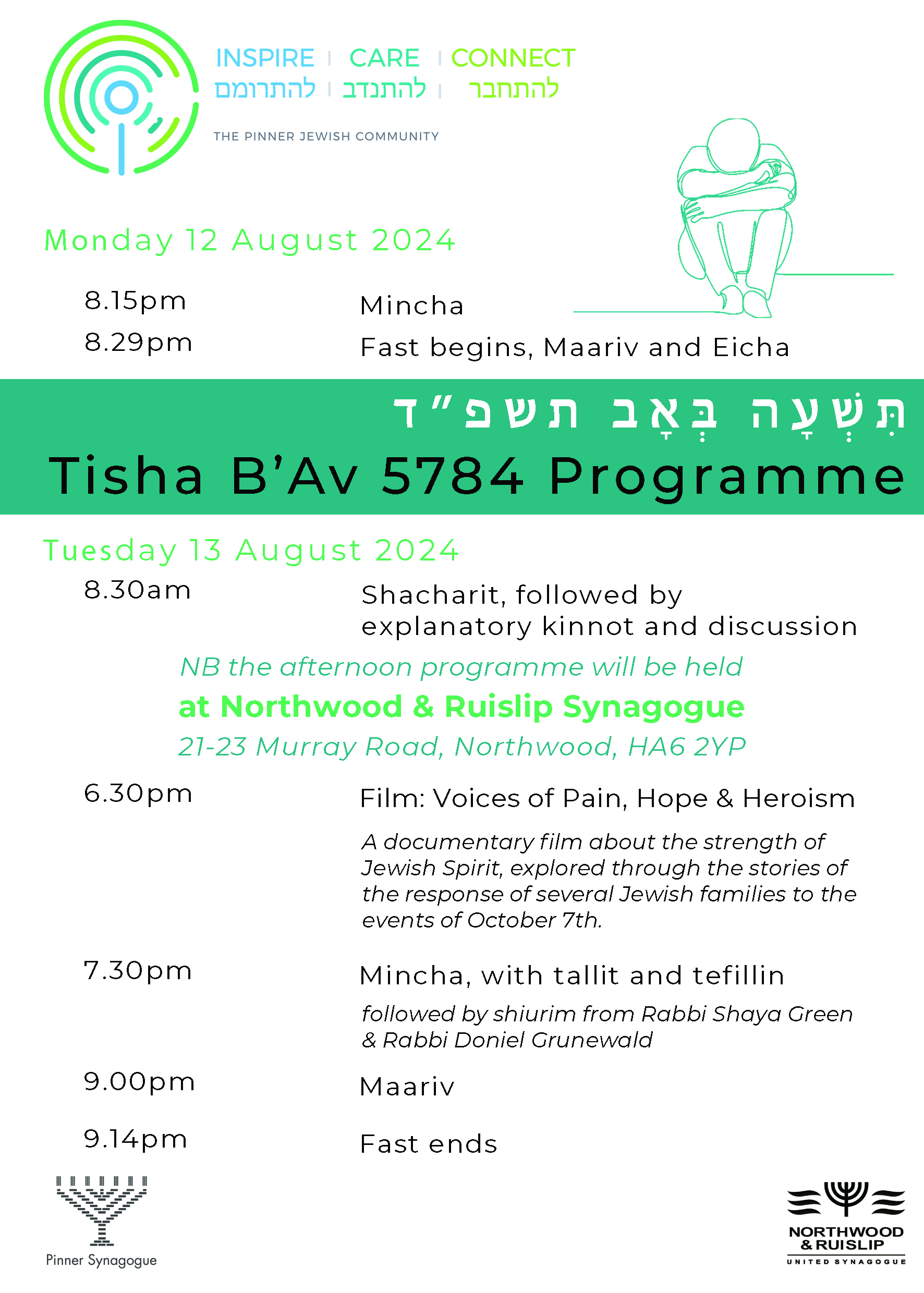
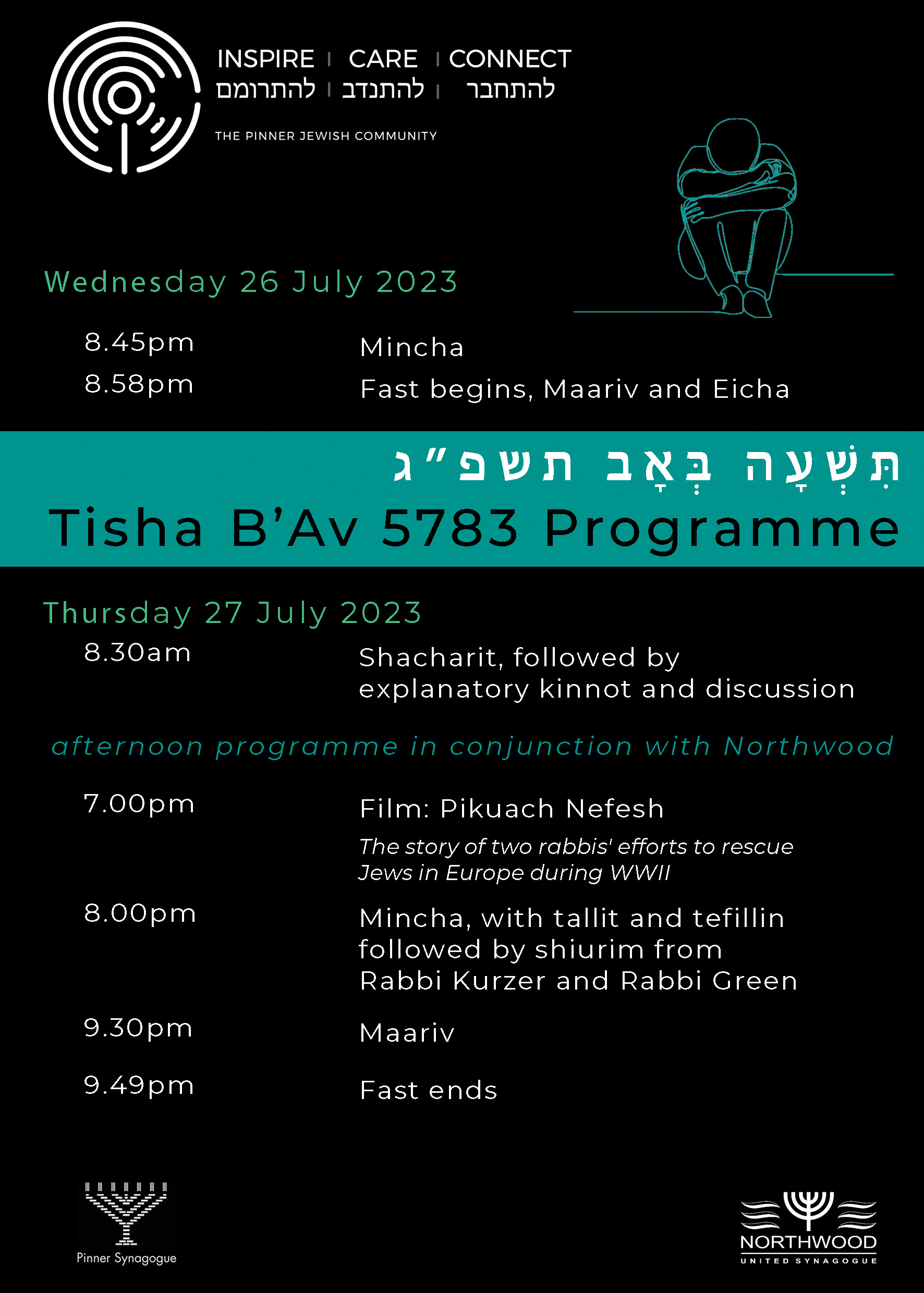
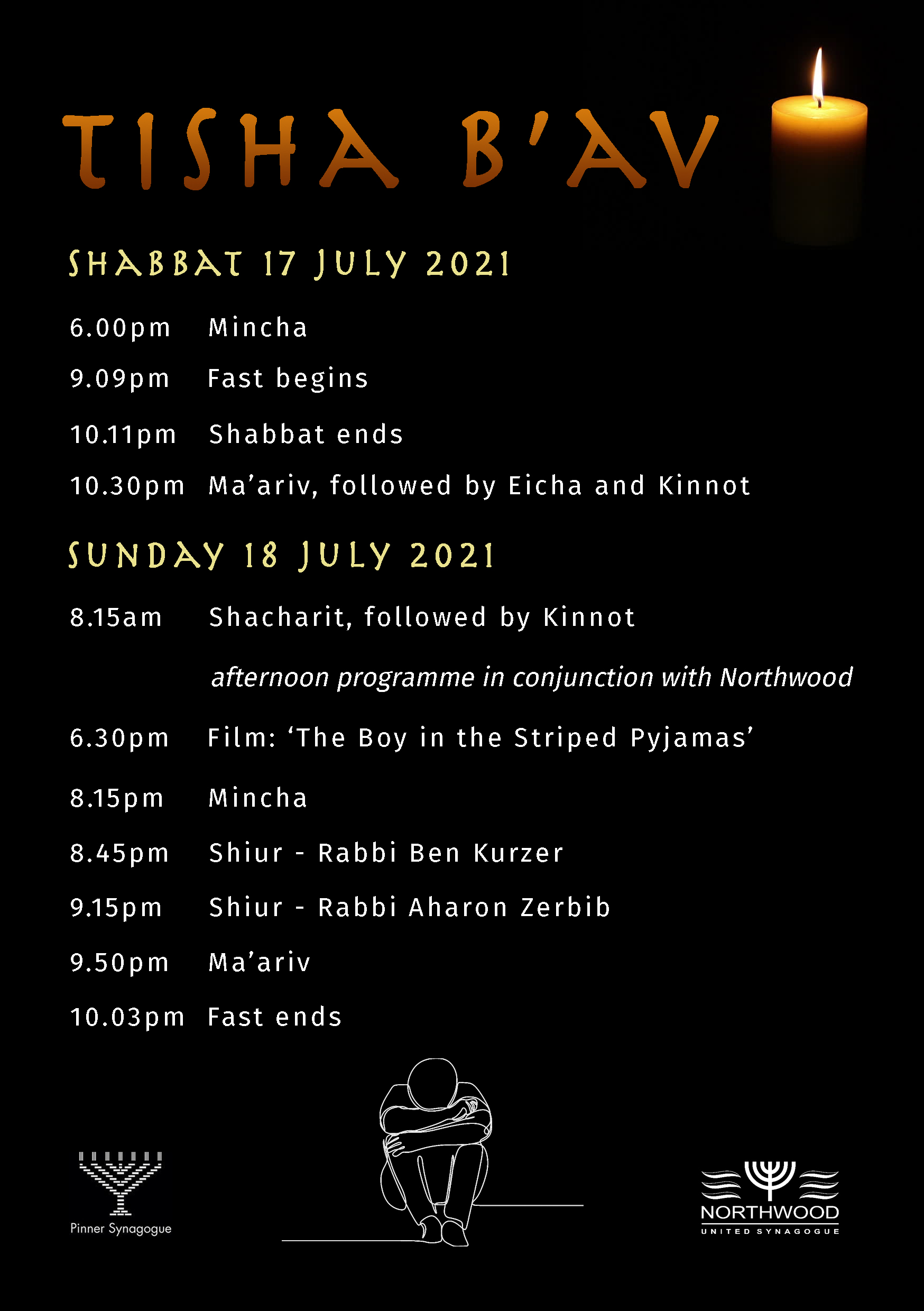
We run a meaningful programme throughout the day – see below for recent programmes, run in conjunction with Northwood & Ruislip United Synagogue.

We are proud to celebrate Yom Ha’Atzmaut (יום העצמאות), commemorating the Israeli Declaration of Independence in 1948 and Yom Yerushalayim, Jerusalem Day (יום ירושלים) marking the reunification of Jerusalem and the establishment of Israeli control over the Old City in the aftermath of the June 1967 Six-Day War.
In 2017, we held a special celebratory evening to commemorate the 50th anniversary of the reunification of Jerusalem.
